













Coffee machines for real mornings: speed, choice and cleanup
Start with a realistic morning rather than a specification sheet. How many people need coffee, how quickly must it be ready and who will clean the machine? A compact capsule brewer, an automatic coffee machine and a manual espresso setup solve different problems. Coffee machine deals are easiest to evaluate after those needs are clear. This category covers the broad choice; the Espresso Machines and Coffee Makers guides explore more specific equipment decisions.
One person wants a quick cup
A portion-based brewer can reduce the number of preparation decisions. The machine and compatible coffee form a system, so the useful comparison includes capsule availability and price. Bruvi’s B-Pod brewer is an example of a dedicated system. It should not be priced as though it accepts every supermarket capsule. If a discount requires recurring coffee purchases, include that commitment in the budget.
For someone who drinks one style consistently, convenience may matter more than a large menu of drinks. Check the available cup sizes, water-tank access and whether the machine can fit the cup actually used. A tall travel mug may not fit under every outlet. These ordinary details affect everyday use more than a long list of rarely selected settings.
Decide whether connected features solve a real need. Scheduling, remote control and supply reminders can be useful, but they are separate from the brewing mechanism. Bruvi, for example, says its app is optional for operating the brewer. Check the model’s offline controls instead of assuming Wi-Fi is required for every connected machine.
Several people want different drinks
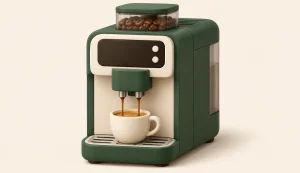
An automatic machine can be attractive when a household wants repeatable preparation with fewer manual steps. However, “automatic” does not describe one fixed feature set. Some machines grind beans, some dispense only coffee and some incorporate milk systems. Check the model’s actual drink functions and whether the milk components require separate cleaning after use.
A shared kitchen also benefits from accessible controls and a straightforward refill process. Consider who can empty the grounds container, clean the drip tray and understand warning messages. The largest capacity is not always the easiest machine to live with if the tank can only be removed from behind a low cabinet.
The machine is part of a hobby
Manual espresso equipment gives the user more involvement in grinding, dosing, distributing and brewing. A lever machine from Flair or Presso/ROK has a different workflow from a powered machine sold by Rocket Espresso UK. Some manual devices need an external source of hot water and do not include milk steaming. Check what is included before treating the machine price as the price of a complete latte setup.
For filter coffee, automated pouring and weighing can address a different kind of preparation. xBloom Studio combines several functions around filter brewing; it is not interchangeable with a traditional espresso machine simply because both use coffee beans. Identify the desired drink first, then judge whether a particular feature improves that preparation.
A machine budget has more than one line
| Cost | Question to ask |
|---|---|
| Equipment | Are a grinder, kettle or milk accessory needed separately? |
| Coffee supply | Does it use ordinary beans, a particular grind or proprietary capsules? |
| Care | Which filters, cleaning products or replacement parts are specified? |
| Delivery and support | Does the quoted price cover the correct region and service arrangements? |
Compare complete setups at equivalent scope. A machine-and-grinder package may cost more initially while including an item that the cheaper listing omits. Conversely, a free accessory has little value if a suitable version is already owned. Avoid counting a promotional gift at its advertised retail value as though it were money removed from the payment total.
Read a machine offer at model level
Retailer sales can apply to one color, a previous model or a limited bundle. Compare the exact model identifier, condition and included accessories. A large saving on a sold-out variant does not establish an available deal on the replacement. Latteholic’s India catalogue, for example, lists several manufacturers; the relevant product and local support matter more than a generic store-wide percentage.
Measure the available space, including room for lids and removable tanks. For powered equipment, verify the market version and the manufacturer’s requirements for the place it will be used. Imported listings and local listings can differ in support and compatibility. Read the manual and retailer’s service policy rather than assuming identical terms across countries.
Questions that narrow the choice
Is every coffee machine an espresso machine?
No. Coffee machines include several brewing systems. Filter brewers, capsule systems and traditional espresso machines can produce different drinks and require different coffee formats.
Does an integrated grinder remove all manual work?
No. The machine still needs cleaning and maintenance, and the user may need to adjust settings. Check how the selected model handles dosing, brewing and any milk preparation.
How should a percentage-off machine deal be compared?
Compare the exact model’s current price, condition and package contents. The reference price and discount should relate to that item, rather than an unrelated premium model.
Can a coffee subscription make the machine cheaper?
Sometimes, but the reduced initial charge can come with future purchases. Read the required quantity, schedule and cancellation consequences before treating the brewer saving as unconditional.
Does a built-in grinder make a machine suitable for every coffee format?
No. Check whether it accepts whole beans, pre-ground coffee or both, and how the selected setting is used. Capsules and instant powder should only be added where the manufacturer explicitly specifies them; an integrated grinder does not make those formats interchangeable.