














Coffee brewing equipment: build a kit one useful step at a time
Coffee brewing equipment covers more than the brewer itself. Measuring, grinding, heating water, filtering and serving can each involve a separate tool. The point of a useful kit is to make those steps work together. This category approaches equipment deals as a sequence of jobs, helping identify what is needed now, what can be added later and which bundle components may simply duplicate tools already owned.
First: decide what the kit should make
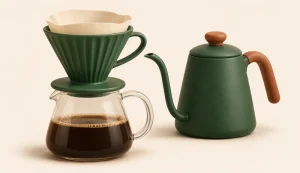
Pour-over, immersion and cold brewing need different arrangements. A manual dripper filters water through a coffee bed as it is poured. An immersion brewer keeps water and grounds together before separation. Cold-brew equipment handles a longer preparation and storage routine. A dedicated device may simplify one method, but it does not automatically replace the tools needed for another.
Choose a normal batch size as well as a method. Brewing one mug at a desk is different from preparing a carafe for a table. A small travel kit can emphasize compact parts and a stable cup; a home kit can prioritize preparation space and easy cleaning. Describe the intended use in a sentence before deciding which advertised features matter.
Then: make measurement repeatable
A scale helps measure coffee and water consistently. Check usable capacity, readability and whether the weighing surface can accommodate the brewer or serving vessel. A timer can help record a recipe, whether built into a scale or available separately. Neither tool supplies a universally correct recipe; the practical benefit is being able to repeat a preparation and change one variable at a time.
As an illustrative planning exercise, a recipe using 15 grams of coffee and 250 grams of water can be doubled to 30 and 500 when the brewer supports that batch. This example explains proportional measurement rather than recommending one ratio for every coffee. Start with the brewer or roaster’s recipe and adjust deliberately instead of changing several measurements together.
Next: check the parts that must physically fit
- The filter must match the brewer’s specified shape and size.
- The server or mug must support the brewer safely and provide suitable clearance.
- A replacement lid, seal or basket must match the exact product model.
- A scale needs enough space and capacity for the vessel and liquid being weighed.
- A travel case must accommodate the actual version of the equipment, including its accessories.
CHEMEX and HARIO provide examples of systems where filter selection is part of the setup. AeroPress offers several products and accessories whose compatibility should be checked individually. A familiar brand name on two components does not establish that every size or generation fits together.
A useful practice session begins with one recipe, a measured coffee dose and a recorded water quantity. Change just one variable on the next brew so the result is easier to interpret. Buying several new tools at once can obscure which change helped; start with the missing component that makes the current setup easier to repeat.
Choose control where it improves the routine
A kettle designed for controlled pouring can help someone manage a manual dripper. Temperature settings can be useful when following a chosen recipe. Those features have a purpose, but they should not become a reason to buy every premium tool at once. A beginner can learn more from a manageable setup and a recorded recipe than from several unfamiliar devices introduced together.
For cold brewing, consider filtering, storage space and how concentrate will be served. Stumptown’s Filtron guide describes a particular brewer and dilution process. That recipe belongs to that setup; concentrate from another product can require a different dilution. Check both preparation instructions and the capacity of the refrigerator container before buying a large-batch system.
Where an equipment bundle can save money
A matched brewer-and-filter package can simplify a first purchase. A travel bundle can be useful when its cup, case and brewer are genuinely compatible. Compare the actual components with their individual current prices, however, and count only items that will be used. An extra scoop is not an additional saving if a scale already handles measurement and the scoop will remain in a drawer.
Consider replacement supplies and maintenance alongside the initial discount. A low-price brewer with hard-to-source filters can be less convenient than a readily supported alternative. Read cleaning instructions before assuming a glass, metal or plastic part is dishwasher-safe. Materials and construction vary, even when two products perform a similar brewing job.
Short answers for building a kit
Should the brewer or the scale be upgraded first?
Identify the current problem. Difficulty repeating quantities may point toward measurement, while the wrong batch capacity may point toward the brewer. An upgrade should address that specific limitation.
Can a travel kit make every kind of coffee?
Usually it supports a particular method and batch size. Check the coffee format and hot-water requirements rather than assuming that portable equipment replaces a full home setup.
Is a bundle discount useful when some parts are already owned?
Compare the cost of the missing components separately. A package can be convenient without being the cheapest route for an established setup.
Do equipment coupons also apply to replacement filters?
Offer coverage varies. Check whether the promotion covers accessories, consumables or only a named brewer, and confirm any quantity or minimum-spend condition in the final basket.
Can an espresso scale support a full coffee carafe?
Check both rated capacity and platform dimensions. The combined brewer, carafe and water may exceed what a small scale can comfortably support. Choose for the complete loaded setup, with a stable base and a display that remains visible.