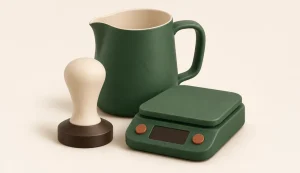





















Coffee accessories: solve the problem before buying the extra
A coffee accessory earns its place by making a particular task easier. That might mean carrying a drink without a spill, weighing a repeatable dose or replacing a worn part. The accessories category includes many unrelated objects, so comparing all of them by discount percentage is rarely useful. Begin with the problem, then check fit, materials, care and the amount paid for the item that actually solves it.
Problem: coffee is awkward to carry
A reusable cup should fit both the intended drink and the journey. Compare usable capacity, overall height, lid operation and whether it fits the bag or cup holder being used. A leak-resistant drinking lid and a fully closed carrying configuration may behave differently. Read the manufacturer’s instructions rather than assuming that every insulated cup can be put sideways in a bag.
SWASHD offers a distinctive example: a reusable cup with a water reservoir designed to rinse the inside after drinking. That feature changes the carry-and-clean routine, but rinsing does not replace the full cleaning described in the care instructions. Consider whether the base reservoir and lid arrangement are useful for the person carrying it. An unusual mechanism is valuable only when it fits the actual routine.
Problem: the same coffee tastes different each morning
A measuring tool can make preparation easier to repeat. A scale is useful for recording coffee and water quantities; a timer can help track a chosen recipe. Check capacity, display visibility and whether the brewer or cup fits on the weighing surface. An espresso scale that must sit under a portafilter needs different dimensions from one supporting a full filter-coffee server.
A scoop can be convenient, but its volume does not establish the same coffee weight across every roast and grind. Decide whether the goal is quick approximation or more consistent measurement. A tool should be judged against that goal instead of treated as a guarantee that every recipe will taste better.
Problem: grounds end up around the basket
Dosing cups, funnels and tamping mats can make a manual espresso workflow tidier. The fit matters: a funnel or tamper must be suitable for the actual basket, and a grinder holder must support the intended portafilter. Check dimensions and the manufacturer’s compatibility list before selecting a generic accessory based only on a familiar-looking photograph.
For portable equipment, model generations can also differ. OutIn’s Nano 2 accessories should be checked separately from accessories designed for the earlier Nano. A shared brand name does not make all parts interchangeable. When replacing a component, record the complete model identifier before shopping.
Problem: an old part needs replacing
Seals, lids, filters and carafes can keep useful equipment in service when suitable replacements are available. Confirm the exact part rather than buying by approximate diameter alone. AeroPress’s official FAQ distinguishes accessory sizes and compatibility within its range; other manufacturers provide their own part lists. Use those references alongside the retailer’s listing.
Care requirements belong in the purchase decision. A part may need hand washing even when another component from the same product is dishwasher-safe. Coatings, seals and insulated assemblies can have different instructions. Read the care guidance before buying several replacements or assuming that a convenient cleaning method is permitted.
Cup clearance matters as much as basket diameter. Measure the space beneath the brewer with the drip tray in its normal position and allow for any scale underneath. For a travel cup, check the lid and handle too. An accessory can have the right capacity and still be awkward to use with the actual machine.
A sensible way to assess accessory bundles
List the components that will be used and compare their individual current prices. A bundle containing four useful cups can be economical for a household. The same bundle can be wasteful for someone who needs one replacement lid. Do not count the value of an unwanted extra as a saving against the purchase originally intended.
SWASHD’s multi-cup offer increases the percentage saving with the bundle quantity. It is a product-specific example, not a category-wide discount. Other stores may exclude accessories from coffee codes or reserve a sale for a particular item. Check that a relevant promotion applies to the selected accessory and include delivery before comparing totals.
For gifts, favor compatibility and usability over novelty. A mug with a comfortable lid or a correctly sized brewing tool can be more useful than a specialist gadget the recipient has no equipment for. If the model is unknown, a general serving item can involve less guessing than a precision replacement part.
Accessory FAQs
Does a self-rinsing cup clean itself completely?
No. A rinse feature serves a particular routine. Follow the maker’s full cleaning instructions for the cup, lid, seals and any reservoir rather than treating a quick rinse as complete maintenance.
Can a tamper be chosen by machine brand alone?
That may be insufficient because basket sizes can differ. Check the actual basket dimensions and the accessory’s compatibility details before purchasing.
Are free accessories equivalent to a cash discount?
Only their usefulness can justify their value to the buyer. Compare the amount paid and the components needed; an extra item does not reduce the checkout charge by its stated retail price.
Will a bean coupon cover cups or replacement parts?
Not necessarily. Read the offer’s product coverage and exclusions, then confirm which basket lines receive the discount before completing the order.
Are all accessories from one brand dishwasher-safe?
No. Care instructions can differ by model and material. AeroPress, for example, gives different washing guidance for particular brewers. Check the exact accessory’s instructions rather than transferring the cleaning method from another product in the same range.